Marshall County Dog Registration Information
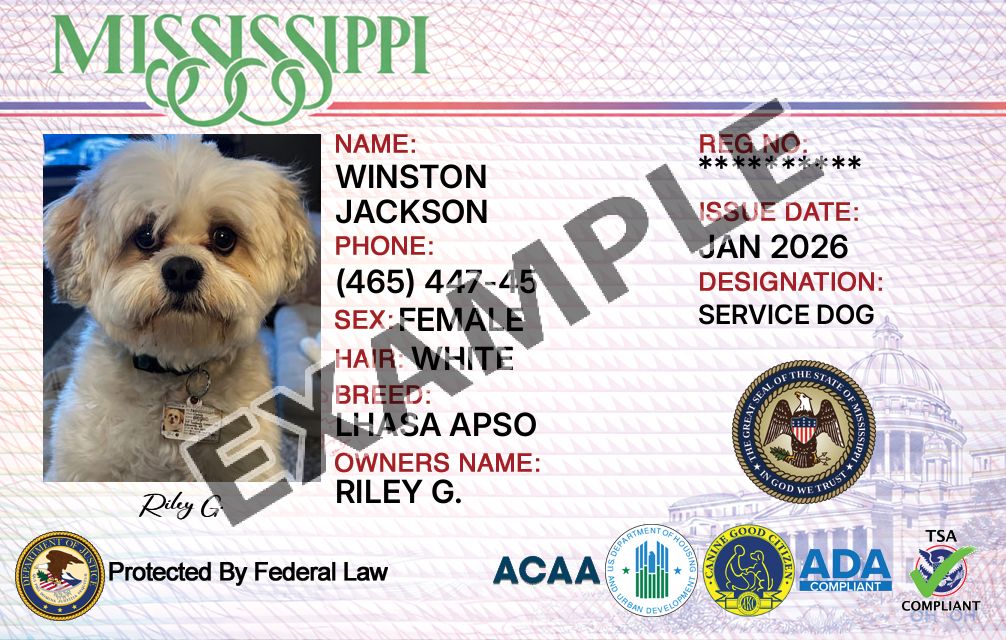
Service Dogs and Emotional Support Animals in Marshall, Mississippi
If you’re searching where do I register my dog in Marshall County, Mississippi for my service dog or emotional support dog, you’re usually looking for two different things: (1) a local dog license in Marshall County, Mississippi (sometimes handled by a city animal department or city hall), and (2) information about service dog or emotional support animal (ESA) status under state and federal law. This page explains how local dog licensing typically works in Marshall County, what to bring, and which local offices to contact for licensing or animal services.
Where to Register or License Your Dog in Marshall County, Mississippi
Offices below are official local government contacts that serve residents in Marshall County, Mississippi. Licensing rules can vary depending on whether you live inside a city/town limit (such as Holly Springs or Byhalia) or in unincorporated Marshall County.
City of Holly Springs Animal Department (Animal Control)
- Phone: 662-252-4652
- Hours: 7 days a week, 8:00 a.m. – 4:00 p.m.
- Note: Listed as a division of the Holly Springs Police Department and references licensing/registration of dogs within city limits.
Town of Byhalia (Town Hall)
- Phone: 662-838-2135
- Hours: Monday – Friday, 8:00 a.m. – 5:00 p.m.
- If you live inside Byhalia town limits, start here to confirm whether dog licensing is handled by town hall, the police department, or another town office.
Overview of Dog Licensing in Marshall County, Mississippi
How licensing typically works locally
In Marshall County, dog licensing is often managed at the city or town level (especially for residents living within municipal limits). For example, the City of Holly Springs describes licensing and registration requirements for dogs within the city limits through its Animal Department. If you’re looking for an animal control dog license Marshall County, Mississippi contact, the correct office may depend on whether you are in Holly Springs, Byhalia, or another municipality.
Rabies vaccination requirements
Mississippi law requires dogs (and cats) of a certain age to be vaccinated against rabies, and local licensing commonly requires proof of current rabies vaccination before a tag or license is issued. In many places, the license tag must be displayed on the dog’s collar when the dog is off your property or as required by local ordinance.
What You Need Before Registering a Dog
Common documents and details
While dog licensing requirements Marshall County, Mississippi can vary by municipality, these are the most common items local offices ask for when you register or renew a dog license:
- Rabies vaccination certificate from a licensed veterinarian (showing vaccination date and expiration)
- Your ID (driver’s license or other government-issued ID)
- Proof of address/residency (especially if licensing fees differ for residents vs. non-residents)
- Dog details such as name, color/markings, approximate age, sex, and breed
- Spay/neuter documentation (if your area offers reduced fees or requires it for certain categories)
- Payment method accepted by the office (fees and payment types vary by municipality)
Service dog or ESA paperwork: what helps (and what does not)
Local dog licensing offices generally focus on vaccination and ownership information. If your dog is a service dog, you typically do not “register” the service dog with a federal government registry. For an ESA, documentation is usually relevant for housing requests rather than public access, and it is not the same thing as a local dog license.
Steps to Register or License a Dog in Marshall County, Mississippi
Step-by-step process (typical workflow)
-
Confirm which jurisdiction you’re in.
If you live inside Holly Springs or Byhalia town limits, start with that city/town office. If you’re in unincorporated Marshall County, ask the closest local government office which agency issues dog licenses for your area.
-
Get your rabies vaccination up to date.
Keep the rabies certificate from your veterinarian; many licensing offices require it before issuing a dog tag.
-
Bring required documentation.
Bring ID, proof of address (if needed), and any spay/neuter documents (if applicable).
-
Apply and pay the licensing fee (if any).
Some areas charge different fees depending on sterilization status, age, or whether it’s an initial license vs. renewal.
-
Receive and display your tag.
If a tag is issued, attach it to your dog’s collar as required by local rules.
-
Renew on time.
Renewals are commonly annual, and you may need updated proof of rabies vaccination when you renew.
If you’re asking “where to register a dog in Marshall County, Mississippi” for a service dog or ESA
In most situations, you still complete the same local licensing steps for a service dog or an emotional support animal as you would for any other dog. The difference is not in “registration,” but in which laws apply to the dog’s access to public places (service dogs) or accommodation requests in housing (ESAs).
Service Dog Laws in Marshall County, Mississippi
No universal registry
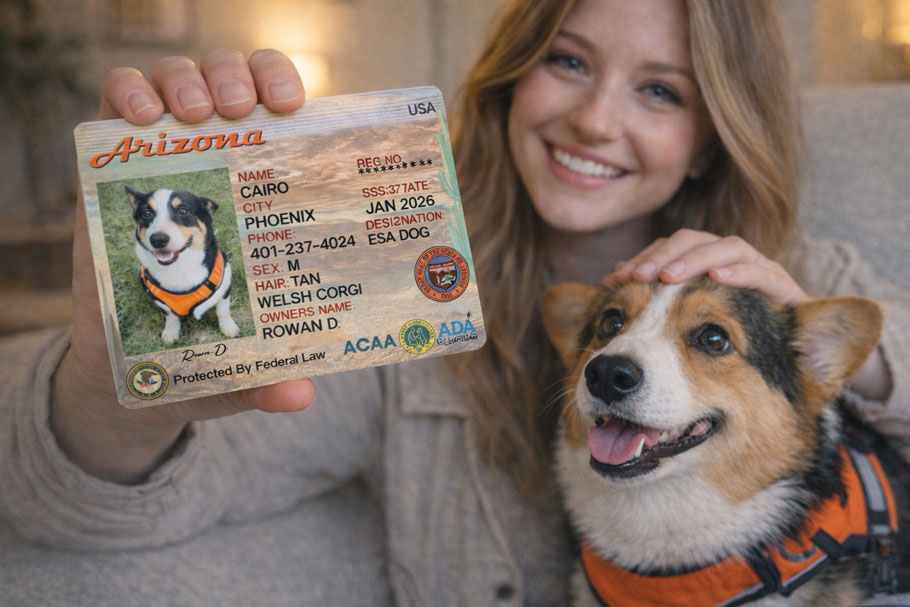
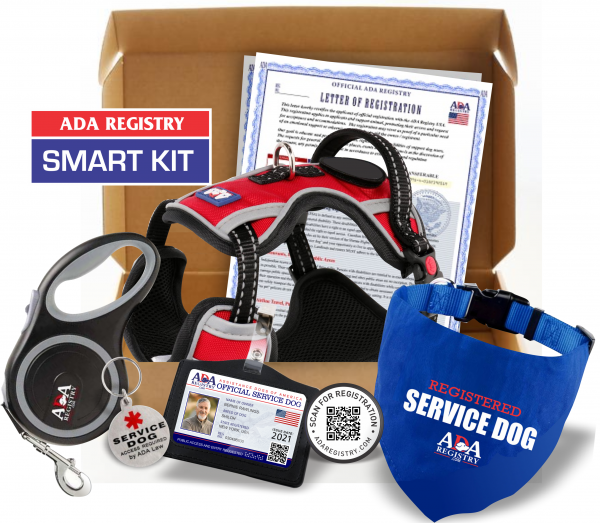
A service dog is not made “official” by paying for an online registration, buying an ID card, or adding the dog to a database. Service dog status is based on training and function: a service dog is trained to perform tasks directly related to a person’s disability.
How service dogs differ from local licensing
A local dog license (if required where you live) is a public health/animal control tool—commonly tied to rabies vaccination and identification. Service dog rights relate to public access and reasonable accommodation rules. Even if your municipality waives certain fees, your dog may still need to comply with local vaccination/tag requirements.
| Category | What it is | Common requirement | Where handled |
|---|---|---|---|
| Dog license | Local license/tag tied to animal control and public health compliance. | Often requires proof of current rabies vaccination; may require renewal on a schedule. | City/town animal department, clerk, or designated local licensing office. |
| Service dog | A dog trained to perform tasks for a person with a disability. | No universal federal registry; public access is based on training and behavior, not “papers.” | Legal status under disability-access laws; local licensing may still apply like any dog. |
| Emotional support animal (ESA) | An animal that provides comfort that helps with symptoms of a disability (commonly in housing contexts). | Not a service dog; generally does not have the same public access rights as a service dog. | Typically addressed through housing accommodation processes; local licensing/vaccination rules still apply. |
Emotional Support Animal Rules in Marshall County, Mississippi
How ESAs differ from service dogs
An emotional support animal can be important support for a person’s mental health or disability-related symptoms, but it is not the same as a service dog. ESAs are generally addressed through housing rules and accommodation requests, not public access rules.
How ESA status relates to dog licensing
ESA status typically does not replace local requirements. If your local area requires a dog license in Marshall County, Mississippi (city or town rules), an ESA is usually expected to follow the same licensing, rabies vaccination, and leash/at-large rules as other dogs.
Frequently Asked Questions
Local variation inside Marshall County
Marshall County includes municipalities (such as Holly Springs and Byhalia) that may have their own ordinances about licensing, leashes, and dogs running at large. If you are unsure which rules apply, confirm whether your address is inside city/town limits before you apply for a license or tag.
What You May Need
-
Proof of rabies vaccinationRabies certificate from a licensed veterinarian (current).
-
Proof of residencyUtility bill, lease, or other document if requested.
-
IdentificationDriver’s license or other government-issued ID.
-
Spay/neuter documentation (if applicable)May help qualify for reduced fees or special licensing categories.
-
Payment for licensing feeFees and payment types vary by municipality.
Disclaimer
Local laws, fees, office locations, and contact details can change. Residents should verify the most current information with their local animal services or licensing office in Marshall County, Mississippi.
Register A Dog In Other Mississippi Counties
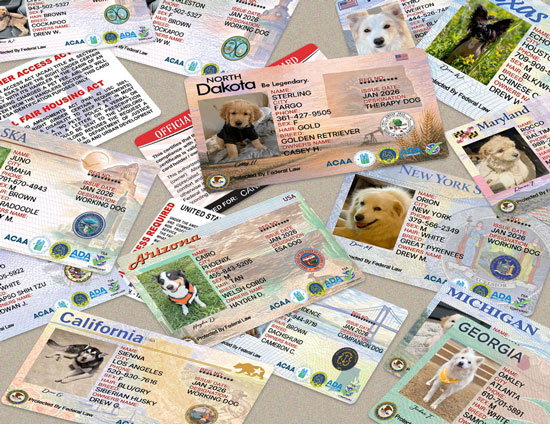
Select your county below to get started with your dog’s ID card. Requirements and license designs may vary by county, so choose your location to see the correct options and complete your pup’s registration.
- Adams County Dog Registration
- Alcorn County Dog Registration
- Amite County Dog Registration
- Attala County Dog Registration
- Benton County Dog Registration
- Bolivar County Dog Registration
- Calhoun County Dog Registration
- Carroll County Dog Registration
- Chickasaw County Dog Registration
- Choctaw County Dog Registration
- Claiborne County Dog Registration
- Clarke County Dog Registration
- Clay County Dog Registration
- Coahoma County Dog Registration
- Copiah County Dog Registration
- Covington County Dog Registration
- DeSoto County Dog Registration
- Forrest County Dog Registration
- Franklin County Dog Registration
- George County Dog Registration
- Greene County Dog Registration
- Grenada County Dog Registration
- Hancock County Dog Registration
- Harrison County Dog Registration
- Hinds County Dog Registration
- Holmes County Dog Registration
- Humphreys County Dog Registration
- Issaquena County Dog Registration
- Itawamba County Dog Registration
- Jackson County Dog Registration
- Jasper County Dog Registration
- Jefferson County Dog Registration
- Jefferson Davis County Dog Registration
- Jones County Dog Registration
- Kemper County Dog Registration
- Lafayette County Dog Registration
- Lamar County Dog Registration
- Lauderdale County Dog Registration
- Lawrence County Dog Registration
- Leake County Dog Registration
- Lee County Dog Registration
- Leflore County Dog Registration
- Lincoln County Dog Registration
- Lowndes County Dog Registration
- Madison County Dog Registration
- Marion County Dog Registration
- Monroe County Dog Registration
- Montgomery County Dog Registration
- Neshoba County Dog Registration
- Newton County Dog Registration
- Noxubee County Dog Registration
- Oktibbeha County Dog Registration
- Panola County Dog Registration
- Pearl River County Dog Registration
- Perry County Dog Registration
- Pike County Dog Registration
- Pontotoc County Dog Registration
- Prentiss County Dog Registration
- Quitman County Dog Registration
- Rankin County Dog Registration
- Scott County Dog Registration
- Sharkey County Dog Registration
- Simpson County Dog Registration
- Smith County Dog Registration
- Stone County Dog Registration
- Sunflower County Dog Registration
- Tallahatchie County Dog Registration
- Tate County Dog Registration
- Tippah County Dog Registration
- Tishomingo County Dog Registration
- Tunica County Dog Registration
- Union County Dog Registration
- Walthall County Dog Registration
- Warren County Dog Registration
- Washington County Dog Registration
- Wayne County Dog Registration
- Webster County Dog Registration
- Wilkinson County Dog Registration
- Winston County Dog Registration
- Yalobusha County Dog Registration
- Yazoo County Dog Registration